Article in the Siskiyou Daily News
Third
year a charm for Campbell
By
Pat Arnold
Daily News Staff Writer
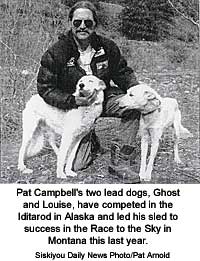 CALLAHAN
— Nine years of hard work have paid off for our dog racing trainer
Pat Campbell of Callahan. After three years of trial and error, Campbell
finished his first race this year, placing 15th out of 25 teams in
the Montana Iditarod — the Race to the Sky.
CALLAHAN
— Nine years of hard work have paid off for our dog racing trainer
Pat Campbell of Callahan. After three years of trial and error, Campbell
finished his first race this year, placing 15th out of 25 teams in
the Montana Iditarod — the Race to the Sky.
Campbell grew up in Minnesota and was around dog racing as a child. He says it was not until dog sled builder Jack Beckstrom introduced him to the sport as an adult that the idea of racing sled dogs took on hew meaning. "The first time I did it, I was hooked on it," Campbell said.
Campbell describes dog racing as a 12-month-a-year job. Even when his 42 dogs are not in training, to care for and create the bond it takes to make a dog want to run 100 miles for a "musher" pulling a sled still takes a tremendous amount of time. Dogs have to be fed and watered twice each day. Campbell will select two dogs to pet and spend quality time with, making it very easy to invest two to three hours a day in just the basic care of his animals. "Some days I am with them from morning to night," Campbell said.
Campbell is a timber faller by trade and is called to work in the spring and summer. With all of the major dog sled races set during the snows of winter, he is lucky to have that time free to concentrate on training and conditioning his dogs.
After giving his dogs the summer off, Campbell starts his dogs out with one- to three-mile runs near home that he increases to 50- to 75-mile training runs as he nears race day. Two teams of eight dogs are hooked to the sled and run for 50 miles or more. Campbell then changes dog teams and goes another 50 miles with the second team.
Campbell said there is no other athlete in the world that can compare with a marathon sled dog. "These dogs travel 50 to 75 miles, rest for four hours and get up and go another 100. They are the top athletes in the world." But to get the most out of an endurance dog, Campbell said a handler has to know a lot about conditioning, nutrition, hydration and basic veterinary care.
When Campbell struck out as a dog sled racer three years ago, he did not come close to finishing his first race. In his second year, he got stuck in a "white-out" and once again could not finish. His third year, he was running second after a third of the race was over, but developed some hydration problems with his dogs and had to drop out.
"Until you get to the point that you really know how to take care of your dogs, you cannot know what problems you will have in a race," Campbell said. So Campbell once again backed out of a race and went home to figure out the nutrition and water retention problems his dogs were experiencing.
This year, Campbell raced his dogs twice, finishing both times. "Now that I have completed two distance races, I am not a beginner anymore," Campbell said. "I have finally gotten over that hump."
Campbell's first race this year was the Attaboy 300 near Bend, Ore. When he ended up 25th out of 27 dogs, he was so excited about getting his program to the point where he could finish a race.
The first year for the Attaboy 300 was 2001, and to promote it, organizers invited top dog sled racers from Germany, France, Canada and Alaska to compete. "It was the top guys from the mushing world," Campbell said, which made Campbell one of only four or five who were not top ranked professionals in the race. "You will never see a line-up like that again," Campbell said.
Totally pumped about finishing his first race, Campbell headed off for Montana to compete in the 350-mile "Race to the Sky," which is considered the toughest dog sled race in the lower 48 states. "The Race to the Sky was my style of race," Campbell said. It featured long pulls in mountainous terrain. Campbell placed 15th out of 25 in a race that took 80 hours, 24 hours a day to complete. "I had the fastest last leg of the race and I know I could have done a little better," Campbell said, already planning his strategy for next year. "The last two miles to the finish, I was so excited because I have been trying to do this for four years."
Campbell
was awarded Sportsman of the Year in that race by the race marshals
and other competitors, and has already been invited to return next
year. His placing in Montana qualified him to compete in the Iditarod
in Alaska, but Campbell says he will have to pass that up for financial
reasons. The cost of provisions for him and his dogs for such a long
race and the cost to hire bush pilots to fly those provisions into
the next checkpoint is just too expensive, he said. "When you
add all that up, it easily comes to $20,000," Campbell said.
At the end of the Montana race, Campbell figured he could have knocked five hours off his time, but decided to run a conservative race and not press his dogs too much. "In this sport, you cannot stress enough dog care," Campbell said. "Sleep deprivation and training are hard, but unless you get nutrition and dog care down right, you are not going anywhere. It was a real joy to put the pieces together and finally see the results."
You can hear the excitement in Campbell's voice as he talks about his dogs and their desire to run 100 miles a day for him. "It is the bond that makes them want to do that for you," Campbell said. "Even now after these races are over, you still shake your head and can't believe we did it. Until you see it, you can't believe it!"
Return to top of page